Ball bouncing down rounded edge stairs
 magyarul
This page is about studying the bouncing motion of a small elastic ball down a rounded stairway. The motion was found to be chaotic in a surprising, tricky way.

You will find here an article dealing with this motion. Solutions to the problems presented in the article can be found in a separate file. The dynamics can be examined by the program "Simulation", in which you can set the parameters and initial conditions.
Articles, problems and their solutions
- the article, published in European Journal of Physics [PDF]
- a shorter Hungarian article in 'Fizikai Szemle' [PDF]
Simulations
The simulations enable you to follow the motion in real space,

... or as a time series of the horizontal (un) and vertical (vn) velocities, taken right after the bounces,

... or as a sequence of velocity-position pairs (un - xn), (vn - xn), the so-called phase space patterns.
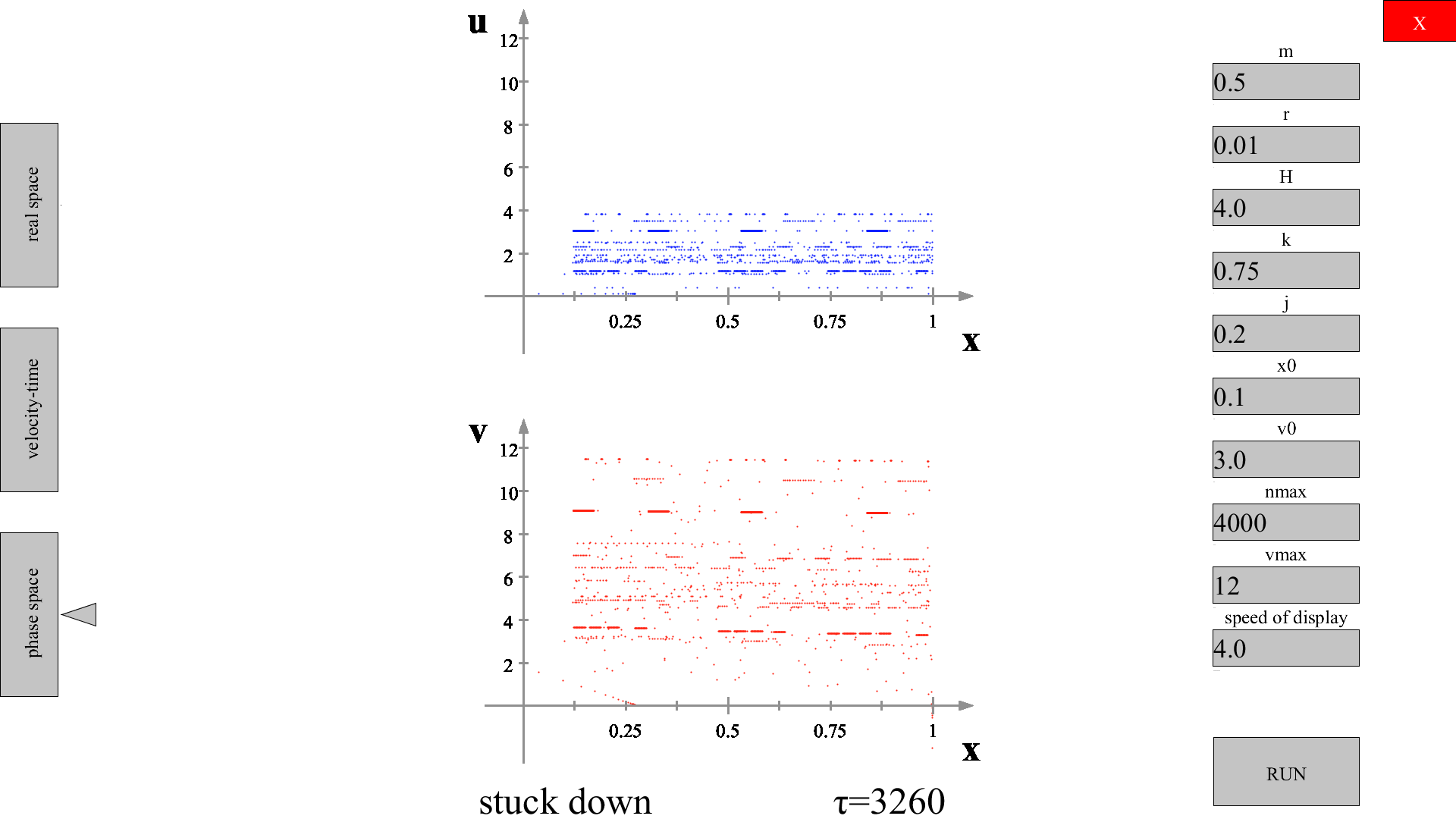
Simulation software:
Notations in the simulations
| Freely choosable parameters: | |
|---|---|
| m | the slope of the staircase |
| H | dynamical parameter |
| r | radius of the curvature on a step whose tread is chosen to be the length unit |
| k | normal COR |
| j | tangential COR (in effect on the roundings only) |
| Initial conditions: | |
| x0 | starting position of the ball on the first step |
| v0 | initial vertical velocity in units of the initial horizontal velocity |
| Parameters for the graphics: | |
| nmax | the number of bounces before simulation stops |
| vmax | velocity cut-off for the diagrams |
Related works
For an analogus webpage for rectangular stairs, see https://pallcsabamatek.hu/lepcso/ (in Hungarian).
Copyright
- Ábel Levente Tóth (email), student, Fazekas Mihály Elementary and High School, Budapest, Hungary
- Tamás Tél, MTA-ELTE Theoretical Physics Group & Institute for Theoretical Physics, Eötvös University, Budapest, Hungary
This work (2019-21) was funded by the Content Pedagogy Research Program of the Hungarian Academy of Sciences.